News · Buying, financing, investing
Buying in the Bas-Chablais: budget, market, steps
Updated
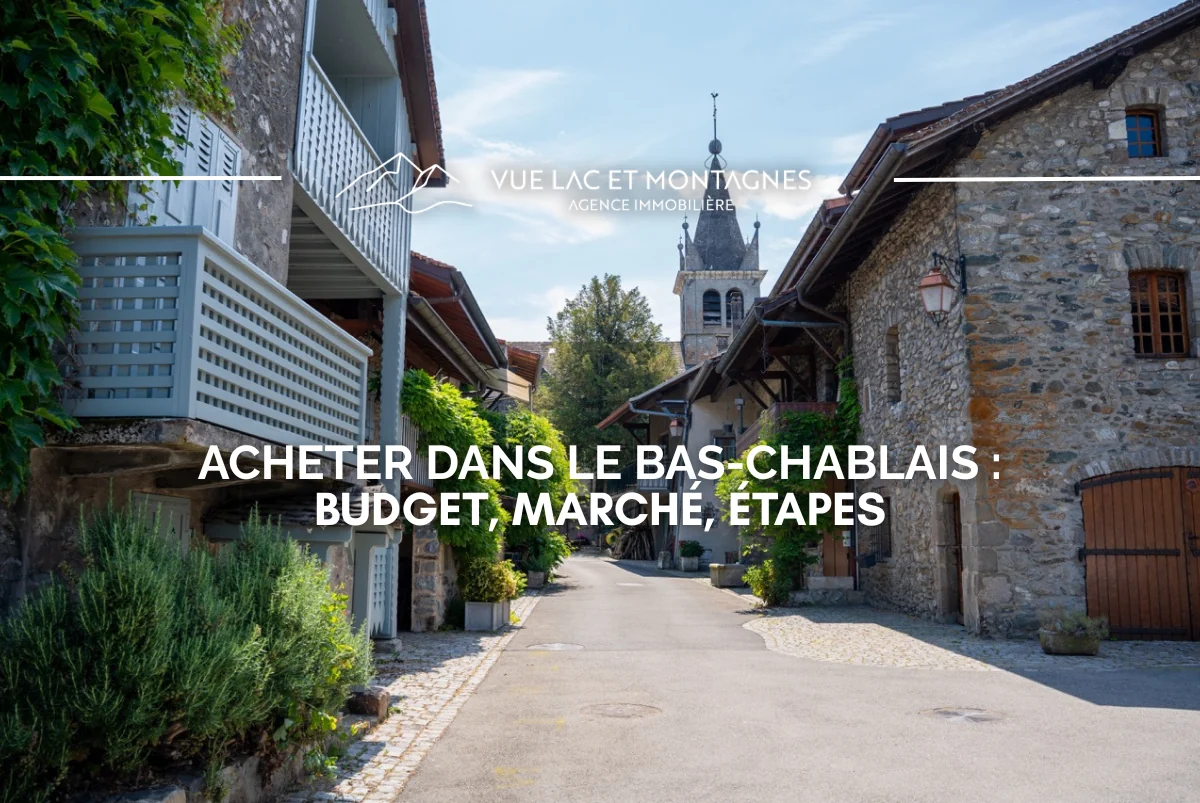
A house with a garden in Messery, an apartment in Douvaine, a building plot in Sciez: the Bas-Chablais, between Lake Geneva and the Swiss border, brings together communes with very different profiles. Buying here takes preparation, as anywhere: project, budget, local prices, then the steps up to the deed. This guide sets them out, with sources.
Define your project before you start looking
Before viewing, settle your project: house or apartment, number of rooms, outdoor space, area, commute to your place of work. The communes of the Bas-Chablais do not all have the same profile. Some are on the lake (Messery, Chens-sur-Léman, Excenevex, Yvoire, Nernier), others further inland (Douvaine, Sciez, Veigy-Foncenex, Massongy, Ballaison, Bons-en-Chablais). For an overview, see Living in the Bas-Chablais.
Set your budget on your borrowing capacity
The budget is worked out from your real borrowing capacity and your deposit, not from a rough estimate. The purchase budget is the sum of the loan and the deposit, less the costs that come on top (see below).
- Debt-to-income ratio. Banks follow the criteria of the High Council for Financial Stability (HCSF): according to the broker ibani, at most 35% of income, borrower insurance included, over 25 years at most (27 years for some off-plan purchases), with a margin of exception limited to 20% of their quarterly lending.
- Loan rates. They change: see Mortgage rates and the usury rate.
- Support schemes. The zero-rate loan (PTZ) can top up the financing of a first main home, subject to income and zone conditions.
- Swiss income. A salary in Swiss francs is converted into euros by the bank with a discount: see our guide for cross-border workers.
A review with a broker before the viewings avoids unpleasant surprises once the offer has been made.
Understand prices, commune by commune
Prices vary widely from one commune to another, and within the same commune: lake view, proximity to the water, living area, plot size, general condition, energy rating (DPE). An average price says nothing about a specific property, and we do not publish a price-per-square-metre grid, which would be misleading. The most reliable way to place a property is to compare it with recent sales of genuinely comparable properties: that is what a valuation carried out by a local agency does.
What we see at the agency. Properties at the right price sell quickly. Houses with a garden within about 20 km of Geneva remain in strong demand. Buyers are paying more and more attention to the energy performance certificate (DPE): it affects the works to plan for and, if you are buying to let, whether the property can be let. These are our field observations, not official statistics: in an active market, it is better to arrive with financing already confirmed so that you can react quickly.
The steps of a purchase
The viewing and the purchase offer. A viewing is used to check the real condition of the property, read the surveys and assess any works. An offer accepted by the seller comes before the preliminary agreement.
The preliminary contract (compromis de vente). It binds seller and buyer. As a rule, the buyer pays a deposit of 10% of the price, held by the notary and deducted from the price at the sale. The contract generally includes a condition precedent for obtaining the loan, with a minimum period of one month. If a condition precedent is not met, the deposit is refunded to you; if you withdraw without a legitimate reason, the seller keeps it.
The cooling-off period. You have 10 calendar days, starting from the day after the first presentation of the registered letter notifying you of the deed. You withdraw by registered letter with acknowledgement of receipt.
The financing. Processing of the file, loan agreement, borrower insurance: this is often the longest phase, especially if your income comes from Switzerland. Start it before signing the preliminary contract.
The deed of sale (acte authentique). Signed at the notary’s office, it formalises the transfer of ownership and marks the handing over of the keys. The signing deadline is set by the parties in the preliminary contract. The compulsory property surveys file must be valid on the date of the preliminary agreement.
What costs should you plan for on top of the price?
- Notary fees: around 7 to 8% of the price for an existing property (an average of 7.7% according to Crédit Agricole), a large part of which is transfer duties (taxes).
- Loan guarantee costs (surety or mortgage) and borrower insurance.
- Brokerage fees, depending on the broker.
- Works, if any, to be costed by a tradesperson before the offer.
If you are buying land to build on, see Building permit or prior declaration and the PLUi-HM of Thonon Agglomération, whose rules apply to all the communes of the area.
Why rely on a local agency?
Buying in the Bas-Chablais means knowing the ground: differences in value between communes, planning rules, local contacts (brokers, notaries). At Vue Lac et Montagnes, we support buyers in Messery, Sciez, Douvaine, Chens-sur-Léman, Veigy-Foncenex and Excenevex. Find out about the agency and our fees.
Frequently asked questions
What total budget should you plan for to buy?
The price of the property, plus notary fees (around 7 to 8% for an existing property), loan guarantee costs, borrower insurance, any brokerage and works. To place a property, see the section on prices above.
What deposit is paid when the preliminary contract is signed?
As a rule 10% of the price. It is held in the notary’s escrow account and deducted from the price at the sale. It is refunded if a condition precedent, such as obtaining the loan, is not met.
Can I withdraw after signing the preliminary contract?
Yes. A non-professional buyer has 10 calendar days, starting from the day after the first presentation of the registered letter notifying them of the deed.
What happens if my bank refuses the loan?
If the preliminary contract includes a condition precedent for obtaining the loan and it is not met, the deposit is refunded to you, on the terms set by the contract. So make your loan applications without delay.
Can I buy in the Bas-Chablais with a Swiss salary?
Yes. French banks lend to cross-border workers: they convert the salary into euros with a discount. The detail is in our guide for cross-border workers.
Sources
Conclusion
Buying in the Bas-Chablais takes preparation: a clear project, a budget based on your real borrowing capacity (costs included), a commune-by-commune reading of prices, then steps to plan ahead: offer, preliminary contract, financing, deed of sale. If you work in Switzerland, also read our guide for cross-border workers.
Tell the agency about your project before you view: we will guide you to the properties that match your budget and your criteria.
Your project
Tell us what you are looking for: we support you from the first viewing to the final sale deed (acte authentique).