News · Planning and local development
Building permit or prior declaration: the procedures
Updated
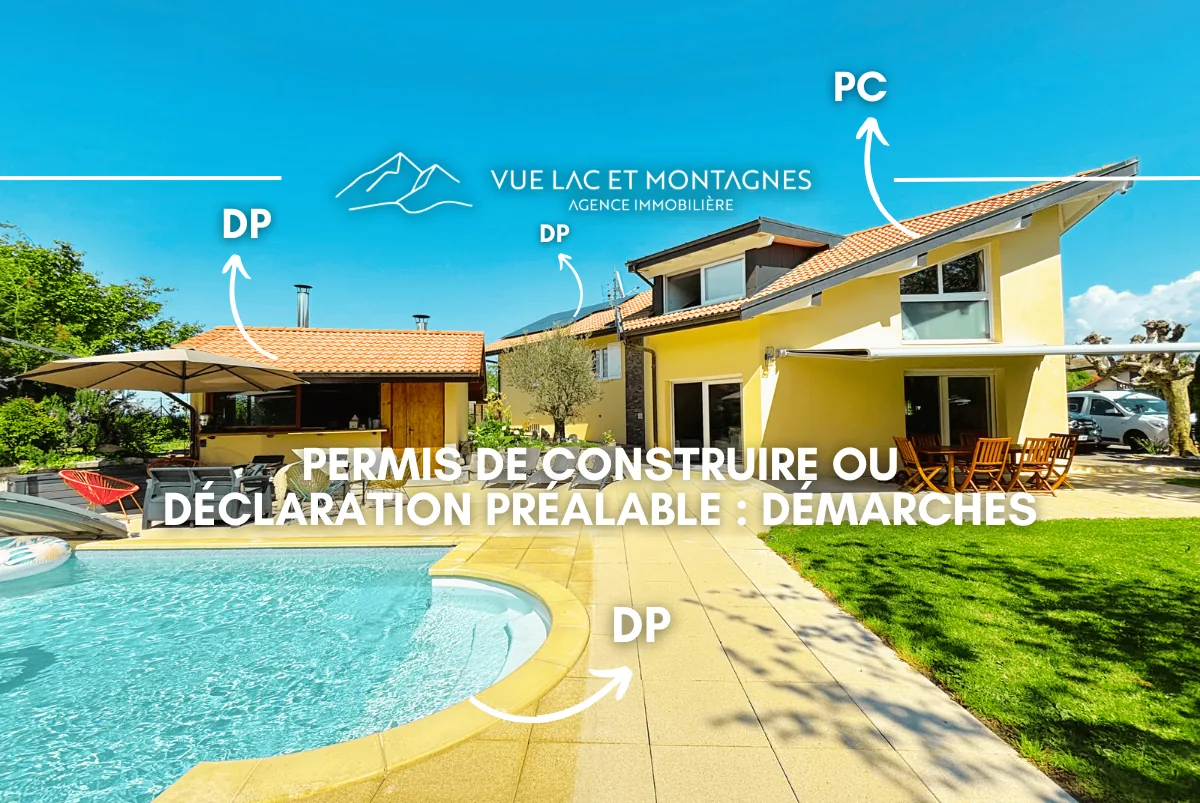
Extension, conservatory, garden shed, swimming pool: before starting works, you need to know whether a prior declaration (déclaration préalable, DP) or a building permit (permis de construire, PC) is needed. The answer depends on the nature of the works, the floor area created and the rules of the planning document. In the Bas-Chablais, this document is the PLUi-HM of Thonon Agglomération, which replaces the former commune PLUs: see what the PLUi-HM changes.
Prior declaration or building permit: the thresholds
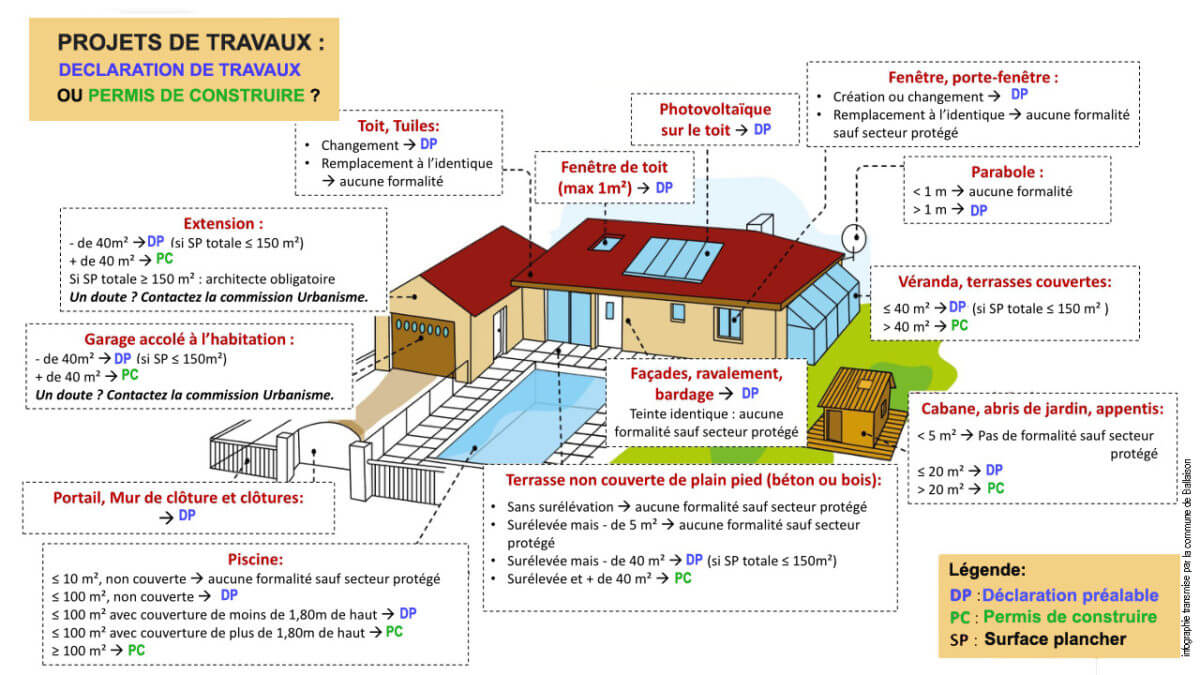
Here are the usual thresholds for a structure attached to a house or an outbuilding. They vary according to the PLU and the situation of the land: check them with your town hall before submitting.
| Project | Prior declaration | Building permit |
|---|---|---|
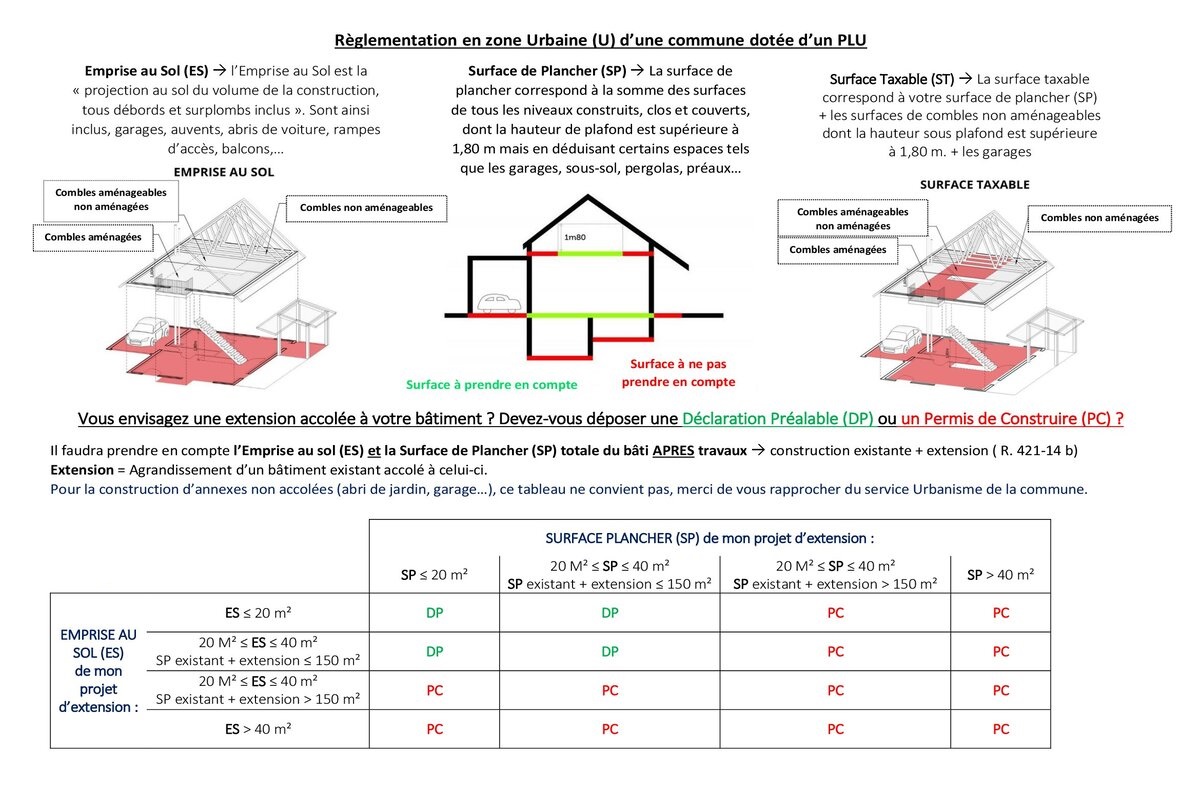
| Extension or conservatory, in a built-up zone of a PLU | Up to 40 m² | Above 40 m² |
| Extension or conservatory, outside a built-up zone | Up to 20 m² | Above 20 m² |
| Outbuilding (garage, workshop, garden shed, pool house) | From 5 to 20 m² (under 5 m²: no authorisation, but the PLU rules still apply) | Above 20 m² |
Two rules are added. A permit is required if the extension takes the house’s total floor area above 150 m², even if the extension stays under 40 m². And using an architect is compulsory above 150 m² of floor area.
Other works also fall under prior declaration, according to local rules: swimming pool, fence, wall, change of roof, windows or shutters, façade renovation, change of use, division into lots. The full list is on the Service-Public page.
Processing times
- Prior declaration: 1 month from submission of a complete file, 2 months in a protected area. If the town hall does not reply, the decision is tacit: it is a non-objection.
- Building permit: 2 months for a single-family house, 3 months for other projects, longer in a protected area. The period only starts once the file is complete.
- Validity: 3 years. Works must start within this period and not be interrupted for more than a year.
After authorisation
Display the authorisation on the land, on a rectangular board of more than 80 cm, legible from the public highway, for the whole duration of the works. Third parties have 2 months to challenge the permit, starting from the first day of a continuous 2-month period of display. At the end of the works, send the town hall the declaration of completion and compliance of the works (DAACT).
The key steps for your works: building permit and prior declaration explained
Floor area, footprint and taxable area
Three different areas serve three purposes. Confusing them is a common mistake.
- Floor area (surface de plancher): the sum of the areas of each enclosed and covered level with a ceiling height of more than 1.80 m, measured inside the walls. Garages and parking areas, non-convertible attics, stairwell openings and the thickness of walls around openings are deducted. It is used to set the type of authorisation, the use of an architect and the PLU limits.
- Footprint (emprise au sol): the vertical projection of the building, overhangs included. Outbuildings such as a garden shed, a carport or a swimming pool count. It is used to set the type of authorisation and to check the PLU limits.
- Taxable area (surface taxable): the basis for calculating the development tax. It takes in enclosed and covered levels with a ceiling height of more than 1.80 m, garages and cellars included, measured inside the façades.
The development tax (taxe d’aménagement)
It is due for most structures subject to authorisation, from 5 m² of floor area created. It is calculated as follows: taxable area × flat-rate value per m² × rate set by the commune and the département. In 2026, the flat-rate value is €892 per m² outside the Île-de-France; a swimming pool is taxed at €251 per m² of pool. The commune rate is between 1% and 5% (up to 20% in some areas), and the département rate is 2.5% at most. Allowances and exemptions exist. The tax is declared within 90 days of completion of the works, on impots.gouv.fr.
The impact of the PLUi-HM on your works
The PLUi-HM rules set, zone by zone, the height of buildings, the footprint, the materials and the colours, and protect natural and agricultural land. A project that meets the thresholds above can still be refused if it does not comply with the rules of its zone. Before submitting a file, consult the rules for your zone on the Thonon Agglomération website (in French) or from your town hall’s planning department.
What do you risk without authorisation?
Works carried out without the necessary authorisation expose you to penalties and later difficulties:
- Criminal penalties: a fine of €1,200 to €6,000 per m² of floor area built, or up to €300,000 in other cases, according to a notary’s office. They are time-barred after 6 years from completion of the works.
- Demolition or bringing into compliance: the commune can ask the judicial court for demolition or compliance for 10 years from completion of the works. A neighbour has 5 years. For a building constructed without authorisation where it was required, the town hall can refuse new applications with no time limit.
- Regularisation: the administration can give notice to submit an application within a maximum of 6 months. The file is then examined under the rules in force on the date of the decision.
- Sale: unauthorised works can expose the seller to a hidden-defect claim, or even to annulment of the sale. There may also be an insurance problem in the event of a claim.
The limitation period does not erase the irregularity: the administration can still object, with no time limit, to a connection to the utilities or to rebuilding after a disaster.
Buying, selling or building: check the authorisations
Before buying a property with an extension, ask for the corresponding authorisations and the certificate of compliance of the works. Before selling, gather them: they are among the documents that the buyer and the notary ask for; see the steps of the sale and the compulsory surveys. To split a plot before building, read land division: steps, rules and precautions.
Do you have a project in the Bas-Chablais? Meet our team: the estate agency Vue Lac et Montagnes in Messery helps you check the position of a property before committing. Contact us to talk about it.
Frequently asked questions
Is a prior declaration or a building permit needed for an extension?
In a built-up zone of a PLU, an extension up to 40 m² falls under prior declaration, above that a building permit. Outside a built-up zone, the threshold is 20 m². A permit is required in all cases if the total floor area exceeds 150 m².
How long does it take to obtain the authorisation?
1 month for a prior declaration (2 months in a protected area). 2 months for a single-family house building permit, 3 months for other projects. The period only starts once the file is complete.
Do you need an architect?
Yes if the project’s floor area exceeds 150 m² after the works. For a legal entity, using an architect is systematic (except for a farm).
Is authorisation needed for a garden shed?
Under 5 m²: no planning authorisation, but the PLU rules still apply. From 5 to 20 m²: prior declaration. Above 20 m²: building permit.
Does a garage count towards floor area?
No: garages and parking areas are deducted from the floor area. They do, however, count in the taxable area for the development tax.
What are the risks for works done without authorisation?
A fine, an obligation to bring the works into compliance or demolish them, and difficulties on sale. Criminal proceedings are time-barred after 6 years from completion, but the limitation period does not regularise the situation.
Sources
- Service-Public: prior declaration (page checked 22 October 2026, in French)
- Service-Public: building permit (page checked 13 February 2026, in French)
- Service-Public: floor area, footprint and taxable area (page checked 27 November 2024, in French)
- Service-Public: planning offences and limitation periods (page checked 25 February 2026, in French)
- Service-Public: development tax, 2026 amounts (in French)
- Notaires: house extension, conservatory, outbuilding, permit or prior declaration (31 July 2026, in French)
- Notaires: unauthorised works, what penalties? (12 November 2024, in French)
- Thonon Agglomération: the PLUi-HM (in French)
Conclusion
For a works project, start with the type of authorisation: the threshold depends on the nature of the works, the floor area created and the PLUi-HM zone. Submit the file before starting, display the authorisation on the land and declare completion of the works. Without authorisation, you risk a fine, an order to bring the works into compliance and difficulties on resale.
A works project, or buying or selling a property with an extension? The agency helps you check the authorisations before you commit.
Free valuation
Free, no-obligation valuation, or simply a conversation about your plans.